
With the current climate in this country, it is important to be cautious, courteous and frugal with the terminology and words we use when speaking about politically charged issues. Describing something with one wrong word could turn into a media frenzy or even get you called out by the president himself.
This is especially true on a college campus, where not only students and staff are constantly present, but also members outside of the university community, sometimes with their children. Some people choose not to let their children hear certain things or believe certain ideologies, especially if there are people screaming their opinion and cameras documenting the entire thing.
Free speech is important, and in a public space like a college campus, it is even more important that free speech is emphasized, and people know that they are safe to have an opinion. Though, when does free speech turn into something else, and when does it cross into causing harm?
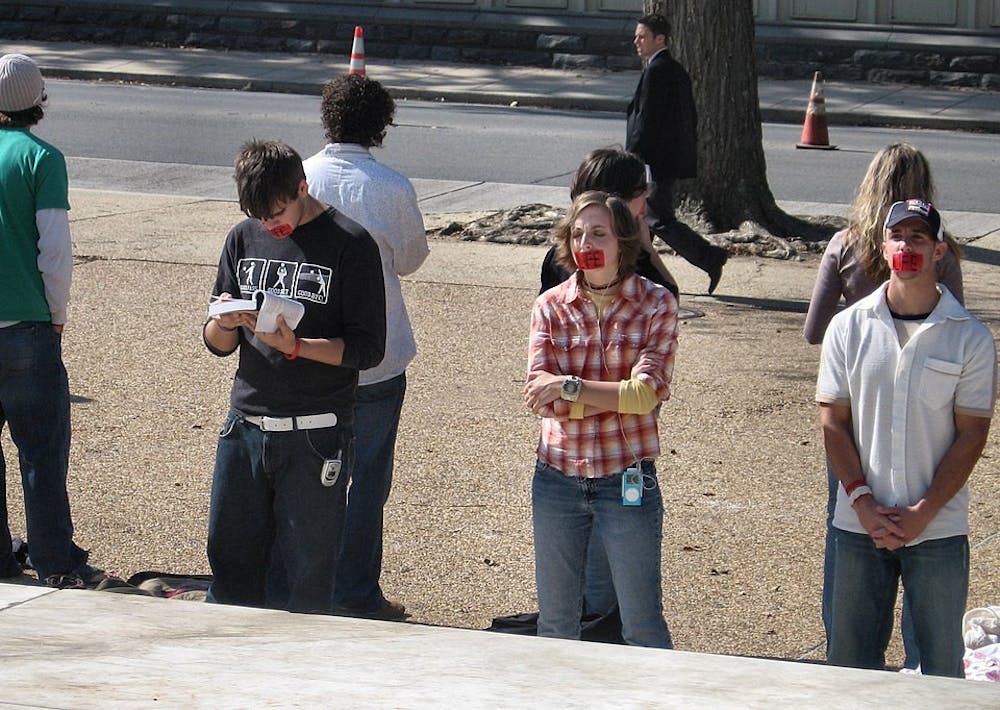
On our campus, there are multiple organizations that tend to host tables with shocking titles, imagery and buzzwords to instigate debates and feelings from people who pass by. This is something that some people may not enjoy, but it is completely fine and, in some cases, good for a healthy conversation.
Recently though, these conversations and tables have gotten more jarring for people walking by and can potentially hurt people in our community.
Many people do not even look at these tables as they pass by. They ignore the people trying to talk to them, and they do not check on upcoming events on campus. But for the people who do, seeing people debate and talk about an experience one may have had as a “human sacrifice” can be extremely harmful.
The specific group that sparked this article had a table in the CUB describing abortion as human sacrifice. The group had a whiteboard where people could tick off whether they agree or disagree with the statement and other small details about the statement around the table. Many people around the table were debating with the people of the organization, and it created a hostile environment in a place that is supposed to foster connection.
Many things were said about the topic, but something I heard was that women who are sexually assaulted and become pregnant see keeping the baby as a healing experience for them when also using therapy and support. This statistic had no factual evidence to back it, and especially hurt people around who were listening who may have had personal experiences relating to the topic, who are going into a field of work relating to the topic or who were just listening.
To emphasize, freedom of speech is incredibly important, and different groups with different ideologies expressing their opinions can be good for our system. When it crosses into causing psychological harm, it becomes different. People should not be leaving an organization's event almost in tears, so angry they cannot think straight, or not even wanting to interact with that organization again.
Hate speech, though largely protected by the First Amendment, is defined by the United Nations in its Plan of Action on Hate Speech as speech that “calls out real or perceived identity factors of an individual or group, including religion, ethnicity, nationality, race, color, descent, gender, but also other characteristics like language, economic or social origin and health status.” It also clearly states in its section about freedom of speech versus hate speech that any restrictions on speech must be exceptional. Those restrictions should seek to prevent harm and ensure equality and the public participation of all.
People do not want a one-sided system. They do not want things to be censored or people to be silenced. It becomes an issue specifically when the things people are advocating for are harming other people and showing our university community in a negative light. Many other organizations on campus have to be vague with their language, but others seem to have no worries. So really, how free is speech with such double standards?
Putting harsh language, shocking images and openly saying things that could cross from just free speech to psychologically or even physically affecting another person should not be allowed in a space where other organizations are trying to educate, support and help everyone, regardless of their ideology.
In a time where so many other things are going wrong, and so many people are in fear of their lives or others' lives already, we should focus on coming together and trying to support everyone during a particularly sorrowful time in politics and human rights. We should avoid constantly debating one another and putting even more of a divide between differing opinions.
Free speech should not be allowed for some who are creating even more division during such a high-intensity time in the world. It is only making it harder for people to come together. Free speech is a right, but hurting someone is not.


The Slate welcomes thoughtful discussion on all of our stories, but please keep comments civil and on-topic. Read our full guidelines here.