
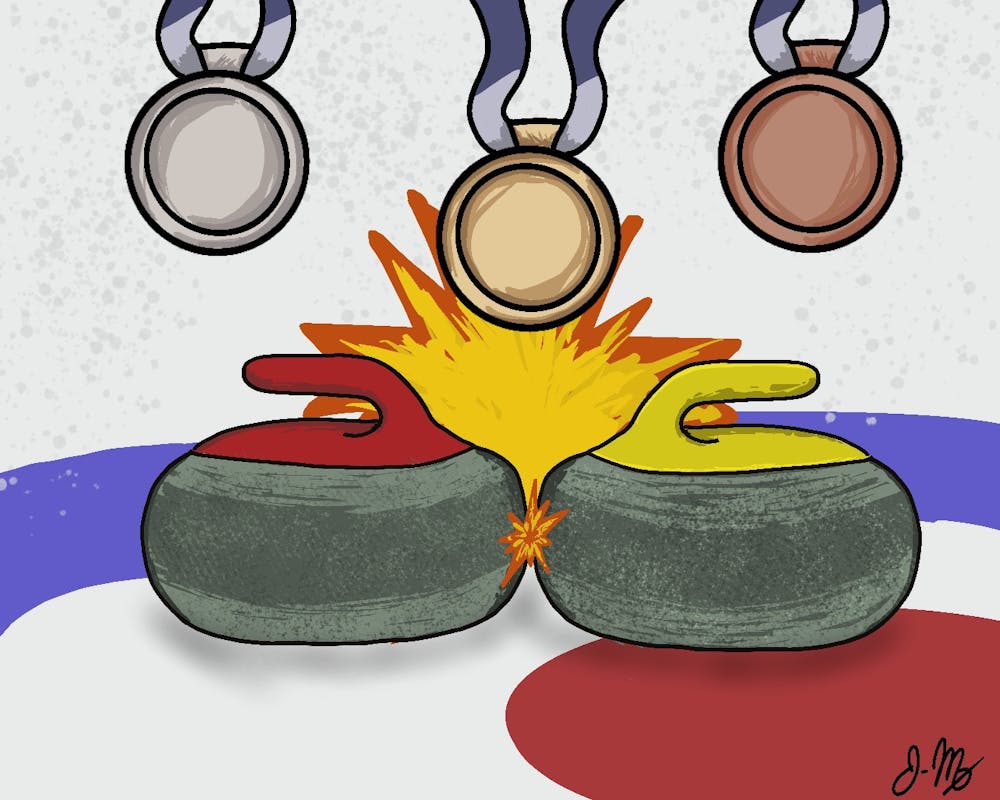
Team USA won gold in men’s ice hockey against Team Canada on Sunday, marking the first time the USA has won the top prize since the “miracle on ice” occurred against Russia 46 years ago during the 1980 Lake Placid, New York games.
We congratulate all of Team USA on the indomitable spirit they brought to all their events in the Milano Cortina Winter Games. That spirit hoisted the Stars and Stripes to tremendous heights, earning them 12 gold medals, which is the most they have ever earned in a single Winter Games.
While this winning spirit allowed our athletes to soar to new heights, it also cushioned the fall as favorites to win in figure skating and skiing events left disappointed with stunning falls and upsets.
As is too often the case, though, politics and public criticism have crept in, bringing questions of athletes’ politics and perceptions of favoritism from the media. With this is also the usual question of whether the games remain relevant. And more troubling is that, as has occurred too often in the history of the games, the specter of another war lingers in the background.
* * *
The Winter Olympics remain relevant, in our view. They rival the entertainment value of any Summer Olympic event. The hard work, dedication and passion that can be seen in every athlete’s performance remain constant, irrespective of the season.
The excitement comes from the fact that the winter sports are creative in design, especially with how risky some events are. Think of the adrenaline of sliding headfirst in skeleton, or how people defy gravity and fly in ski jumping.
The Winter Games also benefit from their optimal scheduling — existing in space between the end of football season and the start of baseball’s spring training. This is a time when drab February weather here in the Northeast and elsewhere keeps people trapped inside.
Some stars of the game “disappointed,” only if you define that by the media and advertising-created standard. Ilia Malinin, “the Quad G0d,” fell during his free skate and did not make the podium for the event.
But a young star, Mikhail Shaidorov of Kazakhstan, was able to bring home the first figure skating gold in his country’s history.
Malinin is still a champion for his gold medal performance that he shared with other skaters for the USA’s gold medal in the team event, and he delivered an emotional and elegant performance in the closing figure skating gala.
The difficulty associated with reaching the Olympic medals in these sports is extreme, and the dedication to earn the chance to compete is proof enough of the game’s relevancy.
But alongside the so-called disappointments were tales of success that will live on for years. Figure skater Alysa Liu is creating new ground in her sport. From facing challenges when she was younger to walking away from the sport, only to come back and take gold with her infectiously joyful routines, she serves as an inspiration for current and future athletes.
* * *
Though the Olympics represent a world coming together for peaceful competition, they too often have lingering global conflicts lying in wait in the background.
The Summer Games were cancelled in the early 20th century due to World War I, and both the 1940 and 1944 games were canceled due to World War II — this on the heels of the 1936 Olympics where Nazi Germany was on the rise while also hosting the games.
These would not be the last, either. The 1972 Olympics saw the “Munich Massacre,” where 11 Israeli athletes and coach were killed in a mass shooting, and 2022 Russia would invade Ukraine days after the 2022 Beijing Winter Olympics, starting a conflict that still lasts today.
Now war is on the horizon again. The United States currently has a fleet — the most firepower since the start of the Iraq War — sitting outside of Iran.
While the world looks on anxiously, one should remember the endearing symbol of unity represented by the Olympic Games in the symbolism of its ever-burning torch. May we one day embody its ideals.


The Slate welcomes thoughtful discussion on all of our stories, but please keep comments civil and on-topic. Read our full guidelines here.