
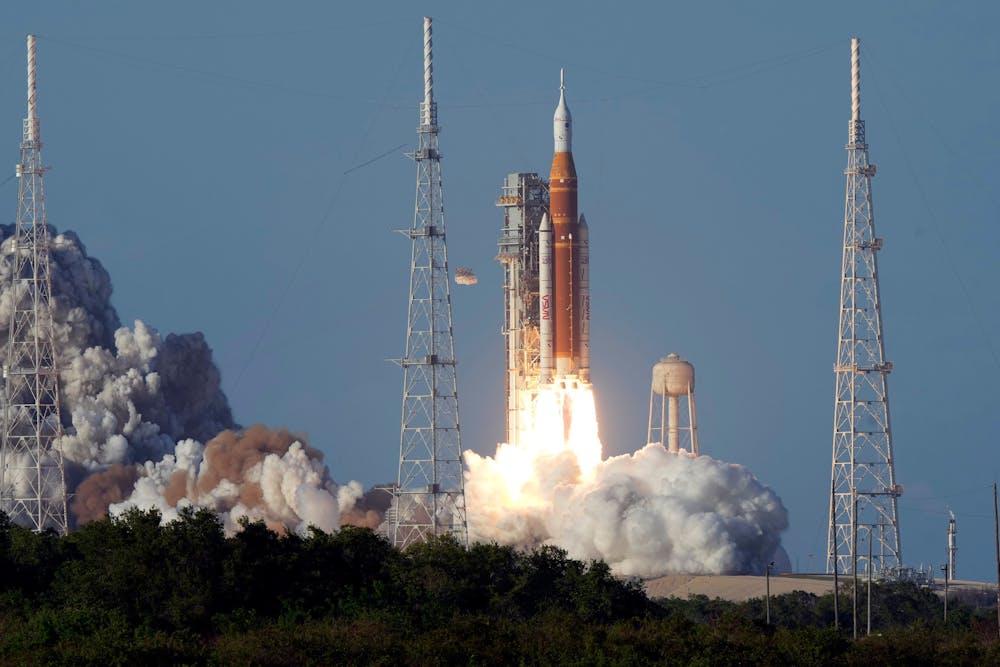
For the past two weeks, it seems like the only thing everyone wanted to talk about was the Artemis II mission. The idea of sending mankind to the moon once again, even if it is just orbiting before heading back to Earth, has captured the attention of the public in a way not a lot of other headlines have. Space travel has the unique ability to unite people, even in times of hardship or political instability.
Unfortunately, humanity’s latest trip to the cosmos has brought out a wave of conspiracy theories.
Ever since the Artemis II mission launched on April 1, my social media feeds have been flooded with people questioning if the mission was real. I have seen theories that the entire mission, and the accompanying video and photo evidence was generated by AI. I have seen theories claiming that space travel is not possible at all for various reasons that are not supported by science. And of course, I have seen the re-emergence of flat Earth theories.
I try not to engage with posts of this nature, but it does leave me wondering why this is such a common phenomenon. I understand speculation, but I do not understand outright scientific denial.
Every theory I have seen that is related to the science of space travel has been easily disproven, either by basic observation or remembering information taught in an elementary or middle school science class.
The theories claiming that the entire mission was generated by AI or that NASA is hiding something from the public make me roll my eyes. The idea that every single government employee and every nation is agreeing to keep quiet about the moon landing has always made me scoff. But, the idea that NASA is lying to the public about this mission when there are hundreds of videos from average citizens of the launch makes me never want to open a social media app again.
I have yet to see a critique or theory regarding space travel or the moon landing that is not rooted in ignorance or a refusal to engage with reality. The content creators I see spreading these conspiracy theories seem to be content with calling anyone who questions them a “sheep” rather than provide a reliable source that disproves decades, if not centuries, of accepted scientific discoveries.
I could go into my own personal theories as to why conspiracy theories of this nature are so prevalent in the age of the Internet, where nearly all human knowledge is at your fingertips. It could be simple ignorance. It could be ego and a desire to know more than others, even if that knowledge is not rooted in the truth or science. It could be a distrust in the government. It could be a combination of all three, but I do not think the reason as to why people buy into conspiracy theories matters much.
What really matters is the accomplishments of the Artemis II crew.
According to a press release from NASA, this mission has allowed humanity to see the far side of the moon for the first time. The crew flew nearly 700,000 miles in total, surpassing the record set by Apollo 13. The crew assisted in investigations into how human tissue responds to microgravity, as well as other tests as to how the human body reacts to deep space. All of this will help NASA create a foundation for future space travel and lunar exploration.
Additionally, Christina Koch, one of the two mission specialists aboard the Orion spacecraft, is now the first woman to travel around the moon. Jeremey Hansen, the other mission specialist, is the first Canadian to orbit the moon. Victor Glover, the pilot, is the first Black man to make the trip around the moon.
All of these accomplishments, whether they be for the astronauts or for scientific discovery, is why space travel is so important.
I have seen many women both in my life and on social media gush about how exciting it is to see a woman be able to achieve her dreams and go to the moon. I have seen people crying with the crew when Hansen named a crater on the moon after mission commander Reid Wiseman’s late wife, Carroll. I have seen so many people around me start to have hope for the first time in a long time.
In this current age of political turmoil and uncertainty, being able to stand together and be united by yet another giant leap for mankind.


The Slate welcomes thoughtful discussion on all of our stories, but please keep comments civil and on-topic. Read our full guidelines here.