
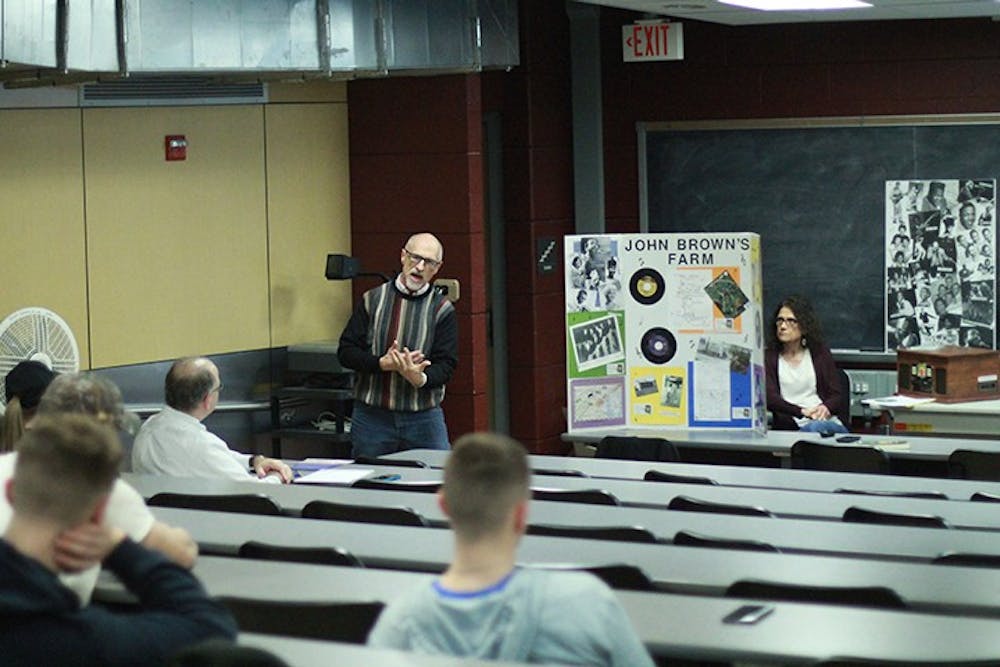
The Shippensburg University History and Philosophy Department hosted the first installment of its “Diggin’ History!” lecture series on Wednesday.
The featured presenter was Ed Maliskas, a high school social studies teacher, who is involved in the preservation and restoration of the John Brown Farm in western Maryland.
Maliskas began the lecture by asking the audience what places and sites they could name with important ties to African-American history. The audience responded with well-known places such as the Edmund Pettus Bridge in Selma, Alabama, the steps of the Lincoln Memorial and the Lorraine Motel where the Rev. Martin Luther King Jr. was assassinated.
However, none of the students named the John Brown farm, a historical site that is less than 60 miles away from the Dauphin Humanities Center lecture hall they were sitting in.
“If the Smithsonian African-American History Museum, or President Obama or Oprah heard of this farm, it’d join the list of all the places you just named,” Maliskas said.
Maliskas began making his passionate argument for the importance of this small farm in “the middle of nowhere.”
“As a preacher, you tell the audience what you’re going to tell them, tell them and tell them what you’ve told them. I’m telling you, the John Brown farm is the most important black history site,” Maliskas said.
The farm was owned by John Brown, a white abolitionist who committed his life to God and ending slavery. Brown worked his entire life to end slavery. In 1859, Brown led a raid on a federal armory in Harpers Ferry to free slaves, but Brown was hanged for this freedom attempt.
John Brown’s story may have ended in 1859, but his farm’s story was just beginning. Fast forward 91 years to 1950, when the Black Elks Fraternal Organization, Improved Benevolent Protective Order of Elks of the World (IBPOEW), purchased the farm and turned it into a highly successful and influential performance venue for African-Americans.
“The John Brown farm drew in many high profile artists, including Ray Charles, Aretha Franklin and James Brown,” Maliskas bragged.
Throughout the 1950s and 1960s the farm became an escape for African-Americans of all ages.
“The weekends at the John Brown farm were the escape from the segregation they faced all week,” Maliskas said. “The farm was extremely hard to find, but it didn’t stop thousands of people from 6,000 square miles away from finding it.”
Maliskas also shared stories from attendees of the concerts — all of which were extremely positive.
One woman said, “It was a family. A wonderful place. We don’t have a place like that today for Black Youth.” She added, “It was so hard to find though. We had a special name for it, ‘The You Can’t Find It Farm.’”
The lecture concluded with a short period of questions and answers. Lastly, Maliskas reminded the audience of the importance of the farm.
“The John Brown farm is important, people just don’t know about it. Now you know about it and can share about it.”
The Slate welcomes thoughtful discussion on all of our stories, but please keep comments civil and on-topic. Read our full guidelines here.