
In 2003, the United States led a coalition into Iraq that drew intense debate, with many questions being raised about why the U.S. is so heavily involved in the Middle East. More than 20 years later, the same questions are now arising regarding the current 2026 Iran war.
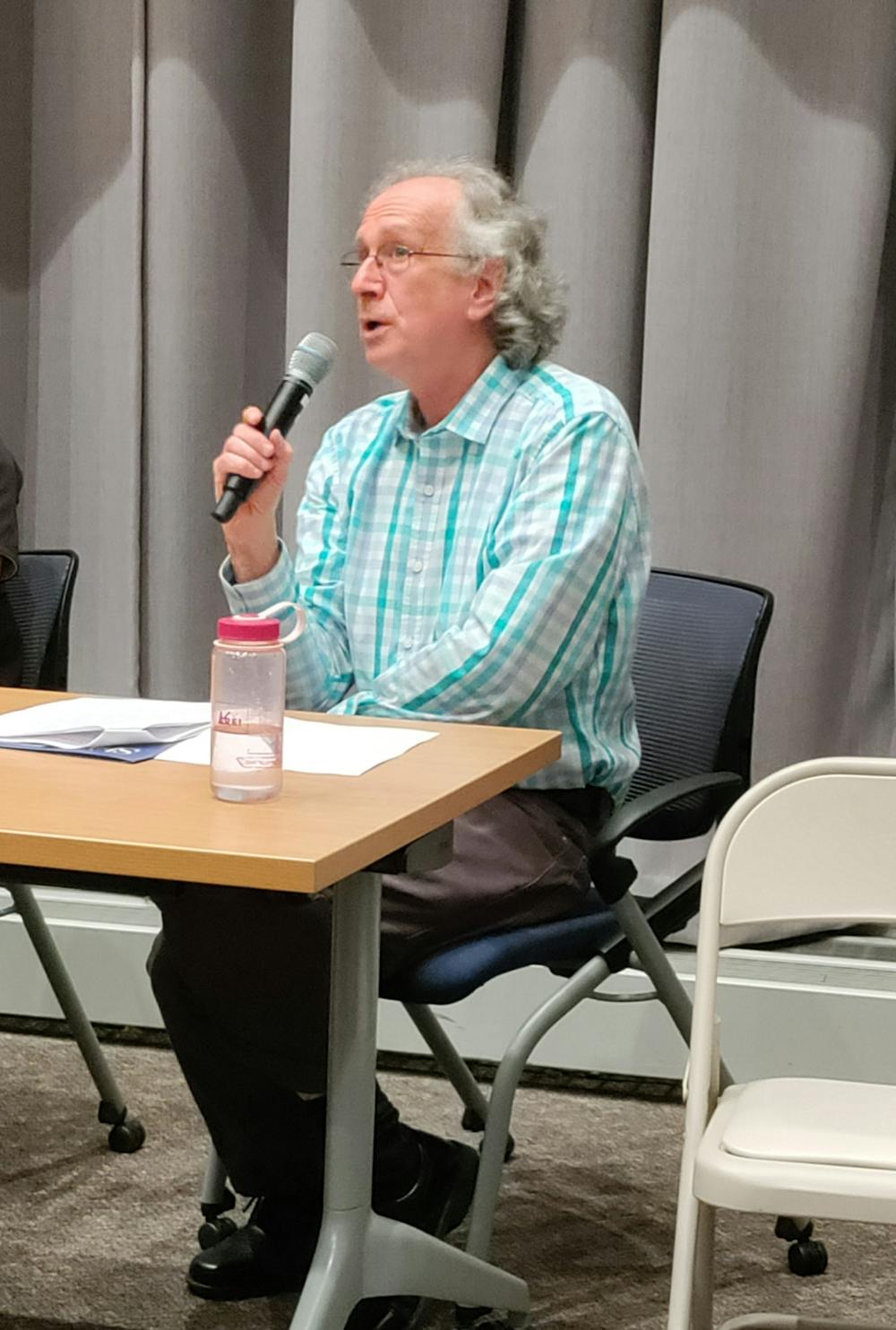
To help address these questions and provide historical context, a panel discussion on the background and impact of the Iran war was held by four academics on Thursday, March 26, in Grove 101.
Thursday night’s discussion was moderated by political science professor Mark Sachleben, who set the topics, asked questions and addressed student questions for the panelists. To Sachleben, moderation also meant keeping the tone of the discussion calm and insightful.
“Keep in mind that there are loved ones of people in this audience who are directly involved on all sides of this conflict,” he said. “We are here to learn about how other people understand and appreciate the world.”
During his opening remarks, Sachleben also introduced the audience to each of the four speakers. In attendance were SU Professor of history Brian Ulrich; Dickinson College Chair of Middle East Studies and Associate Professor Mireille Rebeiz; Associate Professor of Geology Sean Cornell; and Professor Emeritus of History Robert Shaffer.
Ulrich spoke first, providing the historical context behind Iran’s involvement in the Middle Eastern conflict. His brief lecture focused on the Islamic government of Iran, Iran’s Islamic Revolutionary Guard Corps (IRGC) and the Iranian government’s capabilities to manufacture a nuclear arsenal.
According to Ulrich, the Iranian nuclear program began under the previous government to provide energy for the nation. The debate over whether Iran is pursuing nuclear weapons was the last point of Ulrich’s speech.
“This is a little more complicated,” he said. “There are debates within Muslim theology over whether nuclear weapons are compatible with the Muslim rules of war.” Iran’s religious leadership throughout the past decades has been largely opposed to nuclear armament, he explained.
The microphone was then turned over to Rebeiz, who spoke from her experience as a Lebanese woman with family in Lebanon and a scholar of Middle East Studies. As such, her focus was on the actions of Hezbollah in Lebanon and the occupation of Southern Lebanon by the Israeli military in the 1980s.
of the Iranian Revolution as a part of what she called “the Iranization of the region.”
She condemned both the actions of Hezbollah and of the Israeli occupying force, which she believes drove radicalization toward Hezbollah in Lebanon.
“They use and abuse the Palestinian cause as one of their mottos,” Rebeiz said when speaking of Hezbollah. “Lebanon is stuck between three far-right regimes: the United States, Israel and Iran, and there’s nothing we can do.”
Cornell pivoted the discussion toward an understanding of the energy impacts that have resulted from the Iran war. He provided a brief PowerPoint presentation on the geological and geographical features that make the Persian Gulf a hotspot for oil and natural gas.
According to Cornell, the key factors that produce oil and natural gas are source rock material, deformation that causes stress and heating on the material, a pocket reservoir for the oil and a surface seal that keeps the resources contained underground.
“The geology of Iran is amazing,” he said. “If it ever stabilizes and you are able to travel there, I highly recommend you travel there because it is a remarkable place.”
Shaffer presented last on the implications of the Iran war in U.S. politics. He gave a lengthy speech focused on the actions of the Trump administration regarding its initiation of the war, its strategy since and the legality of the war.
“The Constitution states that it is Congress that has the power to declare war,” Shaffer said. “[Trump] is basically saying that he is not constrained by the Constitution.”
According to Shaffer, what makes situations like the Iran war unique is that there was no formal declaration of war, which emboldens the Executive branch to launch military operations without congressional approval.
The United Nations outlines the two reasons to go to war: defense against invasion and a collective vote by the Security Council that calls for intervention.
“Neither of those happened in this case,” he said. “How do you enforce United Nations law? Well, the Security Council can do it, but the United States has a veto, and the International Criminal Court can do it, but on one hand that takes years and the United States hasn’t recognized the authority of the International Criminal Court.”
Following Shaffer’s speech, Sachleben invited the audience to ask questions to the panelists, of which several were asked. Toward the end of the panel, one student asked if Donald Trump is acting as a rogue president, drawing discussion from each of the speakers.
According to Rebeiz, Trump’s actions are a continuation of American foreign policy that has destabilized the Middle East. She spoke about George W. Bush’s memoir regarding the U.S. invasion of Iraq, which she described as a mistake with a severe civilian death toll.
“The reality is Democrat or Republican, for me as a Middle Easterner aside from my expertise, we are described as a place [of] American interests,” she said. “When I hear that I’m hearing colonization, imperialism, slavery, oil and gas. My kids don’t matter. My nephews don’t matter.”
“The whole debate about what Trump is threatening and postponing is about attacking Iran’s energy infrastructure. Not the production but the civilian uses, which is a war crime,” Shaffer said. “That’s where the debate is … not is it right to do this but should we do it tomorrow or should we do it [ten days from now].”
Although it was scheduled until 8:15, Thursday night’s discussion ran until shortly after 9:00 p.m. Independent questions for the panelists from attendees were accepted past the conclusion.


The Slate welcomes thoughtful discussion on all of our stories, but please keep comments civil and on-topic. Read our full guidelines here.