
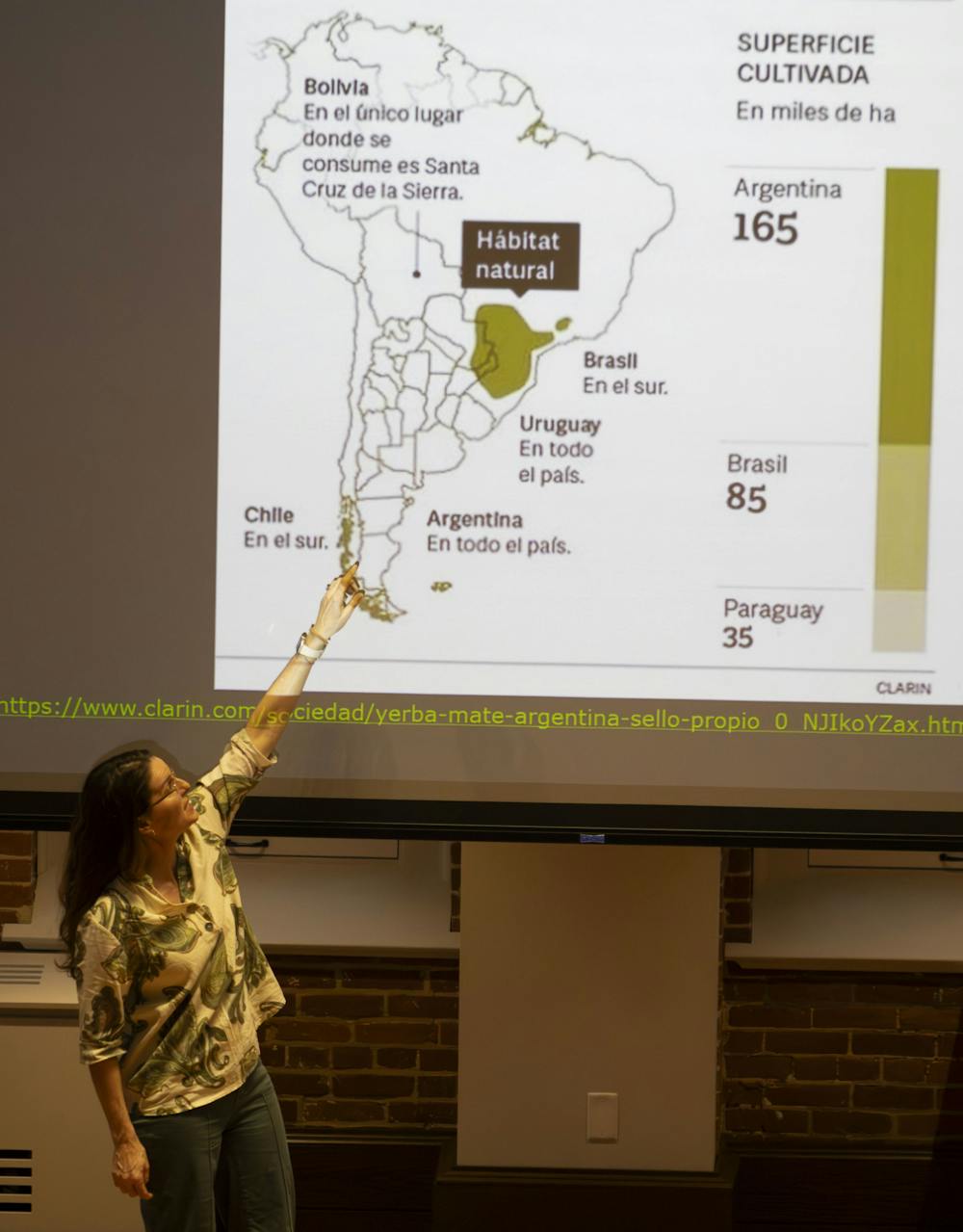
A packed Stewart Hall audience heard historian Rebekah Pite on Wednesday night argue that yerba mate is far more than a drink in South America, serving instead as a lens through which to understand the region’s identity, labor history and political resistance.
Pite, a history professor at Lafayette College, spoke on March 11 as Shippensburg University’s Annual World History Speaker. SU history Professor Mark Spicka introduced her, and the event filled the room, with some students sitting on the floor after seats ran out. Pite’s lecture drew on her 2023 book, “Sharing Yerba Mate: How South America’s Most Popular Drink Defined a Region.”
The talk, which shared the title of the book, was sponsored by the Department of History and Philosophy, the History Club, International Studies, the College of Arts and Sciences and the General Education Program.
Early in the lecture, Pite asked audience members to raise their hands if they had tried coffee, tea or hot chocolate, drawing a broad response across the room. When she asked who had tried yerba mate, only a few hands appeared to go up, underscoring one of the central points of her talk. While coffee, tea and hot chocolate became globally familiar, yerba mate remained much more closely tied to South America.
Drawing from her research on the Southern Cone, Pite said she began studying yerba mate to better explain a side of the region often overshadowed by scholarships focused on dictatorship, war and economic crisis.
“My decision to study yerba mate came out of a kind of bigger tension,” Pite said. “The things I experienced when I was in the Southern Cone region was a lot of connection, a lot of sociability and a lot of joy. And then the studies that I often read and taught about this region focus on a lot of hardship.”
Pite said yerba mate, traditionally shared from the same cup and metal straw, became a daily social ritual across Argentina, Uruguay, Paraguay and southern Brazil. She described it as both a commodity and a practice, one that reveals how people built relationships, expressed belonging and carried traditions across generations.
“It is this kind of, to me, beautiful ritual of incorporation,” Pite said.
She said the communal nature of yerba mate also made it a meaningful way for newcomers to enter social life in the region. Immigrants, she said, often learned to drink mate before learning to speak Spanish or Portuguese.
At the same time, Pite stressed that the history of yerba mate is also a history of unequal labor. She traced the drink to Indigenous Guaraní communities, who introduced the plant to Spanish colonizers and taught them how to preserve and consume it. But, she said, the workers who produced yerba mate often saw little return from that labor.
“One of the big points I want to make here is that Indigenous laborers teach the Europeans how to preserve the yerba, how to consume the yerba, and they do most of the labor to produce it,” Pite said. “But they make little or no money on it.”
That imbalance, she said, remained central even as mate became a strong marker of regional identity. Pite also argued that yerba mate was not only a symbol of national identity but also a source of comfort and resistance. She pointed to labor protests and factory sit-ins in which workers drank mate while defending their interests, and she discussed Uruguay, where mate became associated with opposition to dictatorship and with leftist political resistance.
During a question-and-answer session, Pite expanded on the cultural and spiritual history of the drink. She said Guaraní traditions attached spiritual meaning to yerba mate and included origin stories in which the plant functioned almost as a kind of salvation. She also said some early clergy viewed the drink with suspicion.
“One father brings a case to the Inquisition saying yerba mate needs to be tried, and it’s a sign of the devil,” Pite said.
At the same time, she added, there is evidence that people drank mate to stay awake during Catholic masses, showing how deeply the practice had become embedded in daily life.
Pite also discussed the way the COVID-19 pandemic disrupted one of mate’s defining customs: passing a single cup among friends, family and co-workers. Even so, she said the long history of the practice suggests it will continue.
“Given the 500 years of history of sharing, I don’t see it going anywhere,” Pite said.


The Slate welcomes thoughtful discussion on all of our stories, but please keep comments civil and on-topic. Read our full guidelines here.