
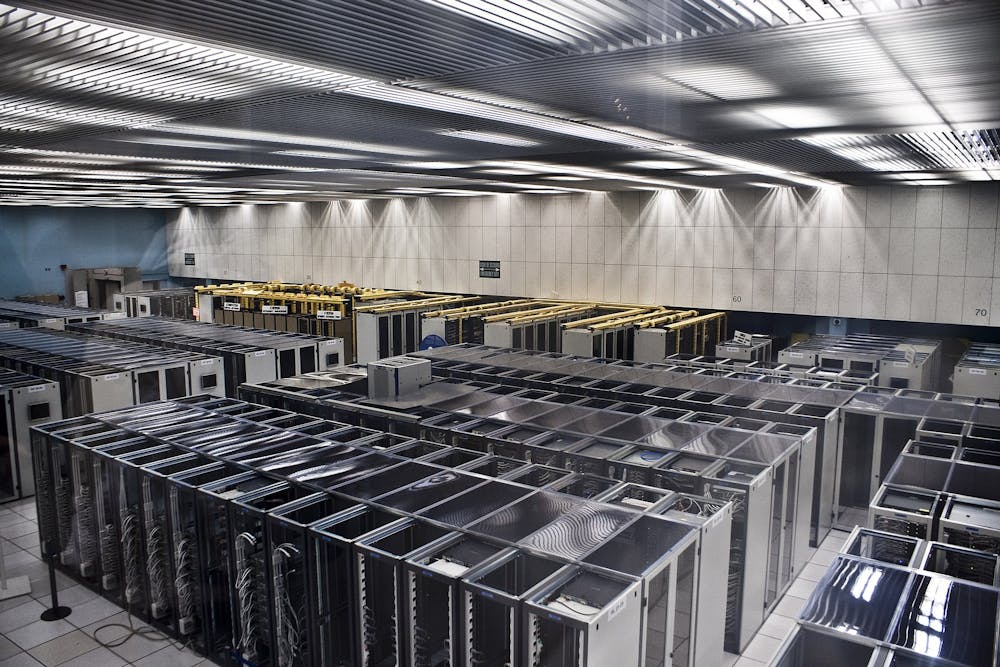
There is no better physical example of our dystopian slide than the monolithic data centers that power artificial intelligence cropping all over Pennsylvania and the country.
So, kudos are in order for the Franklin County Board of Commissioners Chairman Dean Hourst and Franklin County Administrator Carrie Grey, who instructed their fellow county commissioners to look into creating zoning guidelines for townships without such laws to handle the influx of developers looking for land for future data centers.
The missive, which was made during a late January commissioners’ meeting, is an important one because there is little to stop giant tech companies from purchasing land and propping up a campus of servers that consumes more energy than most towns.
This is because around half of the townships in Franklin County do not have zoning laws, which leaves them vulnerable to a laissez-faire state law that says they must allow structures like data centers if they have nothing on the books to prevent them.
Southampton Township officials have been transparent about the threat that a lack of zoning laws poses to their autonomy.
“Pennsylvania municipalities are required by law to provide for ALL land use within their boundaries and may NOT exclude any particular use from their community,” reads a public notice on the township’s website. “If a specific use is not listed in their zoning ordinance, a municipality could experience exclusionary zoning challenges in court.”
In other words, if politicians do not restrict data center zoning, the only thing to prevent them will be a struggling dairy farmer’s decision to cash out and move to a tropical climate as a millionaire — not exactly a promising defense.
Southampton officials, like their county counterparts, are looking to get ahead of that issue. They seek to limit placement and mandate the noise emitted from such buildings, in addition to mandating that 25% of their energy consumption comes from solar panels on site.
The electricity that data centers consume is one of their main rubs. According to Cleanview, a commercial website that tracks data center projects, the center that currently consumes the most power in Pennsylvania is the TierPoint Valley Forge Data Center in Montgomery, which requires about 23 megawatts.
The largest planned center in the Keystone State is the planned Homer City Data Center in Indiana, Pennsylvania. That center is estimated to require 4,500 megawatts, which is more power than all the largest plants currently operating in New Jersey, Pennsylvania and Maryland put together. It will consume enough electricity to power every home in Philadelphia, per a Washington Post analysis of data center projects.
If that does not raise enough alarms, the Homer City campus is one of about 20 planned data centers coming to the state. To power them all will require massive amounts of electricity, and some energy CEO’s are already calling for the unretiring of coal, as was discussed at a summit of energy industry insiders in Las Vegas last year.
All this so internet trolls can post AI videos on social media, and we can continue to lose trust in everything we see, while also living under a surveillance state on a scale never seen before.
For now, most of the planned projects stick to the east, west and north of the state. But energy grids do not respect municipal lines. You can be sure that as AI advances, companies will be looking to areas like Chambersburg and Shippensburg.
What the Franklin County Commissioners have done is set up tools that can be used both for and against data center construction proposals.
It is up to us, the residents of these communities, to provide political pressure to keep big data out of our backyards.


The Slate welcomes thoughtful discussion on all of our stories, but please keep comments civil and on-topic. Read our full guidelines here.