
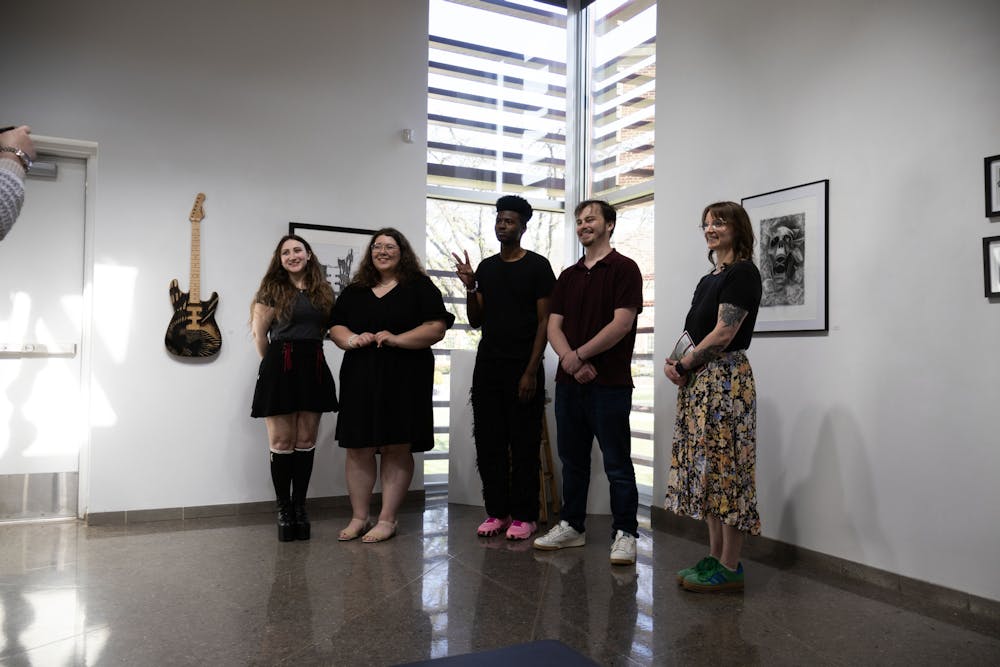
Through printmaking, digital art, ceramics and charcoal drawings, Shippensburg University senior art students used their capstone exhibition to explore censorship, artificial intelligence, horror and personal transformation Thursday at the Huber Art Center.
The 4 p.m. opening reception featured work from Luke Lindvall, Gerald Pratt, Kaylee Will, Alayna Mandich and Lily Bramucci. Students, faculty, family members and friends moved through the gallery as the artists introduced their work and discussed the ideas behind it.
Lindvall said his work pushed printmaking beyond paper by combining the medium with carved objects, including skateboards, a stool, a guitar and a table.
“When I first started printmaking my sophomore year, I knew it was going to be my favorite medium,” Lindvall said. “My overall goal was to see how far I could push this medium and myself to make something I can look at 10 years down the road and still be proud of.”
He said the project came with challenges because he had to change his process while working with objects not typically used for printmaking.
“It was a little scary going into it not knowing if it would even work,” Lindvall said.
Pratt said his charcoal and graphite drawings focused on modern politics and overcensorship.
“My art topic is supposed to be about censorship, not about censorship as a whole, but over-censorship,” Pratt said. “It’s to open up the discussion of how much censorship is too much.”
Pratt said his project started as a different idea based around characters and storytelling before shifting toward censorship.
“It would have been easy to make my art about something more shocking,” Pratt said. “But I decided to go with something more visceral while still appropriate so it could be seen in a public setting.”
Will’s series, “Feed Your Children,” focused on artificial intelligence, technology and their effects on children and future generations.
“I focused a lot on our relationship with technology and the overuse of it,” Will said. “We have a tendency to become overdependent on technology when it comes to raising children.”
Will said her work warns against relying too heavily on technology to shape the next generation.
“If we continue to rely on technology and AI to raise the next generation, it will do more harm than good,” Will said.
Mandich’s digital series, “Metamorphosis,” used horror imagery and fantasy to explore beauty and transformation.
“I’ve always been a fan of horror and scary things,” Mandich said. “I want to show that beauty can coexist with the ugly.”
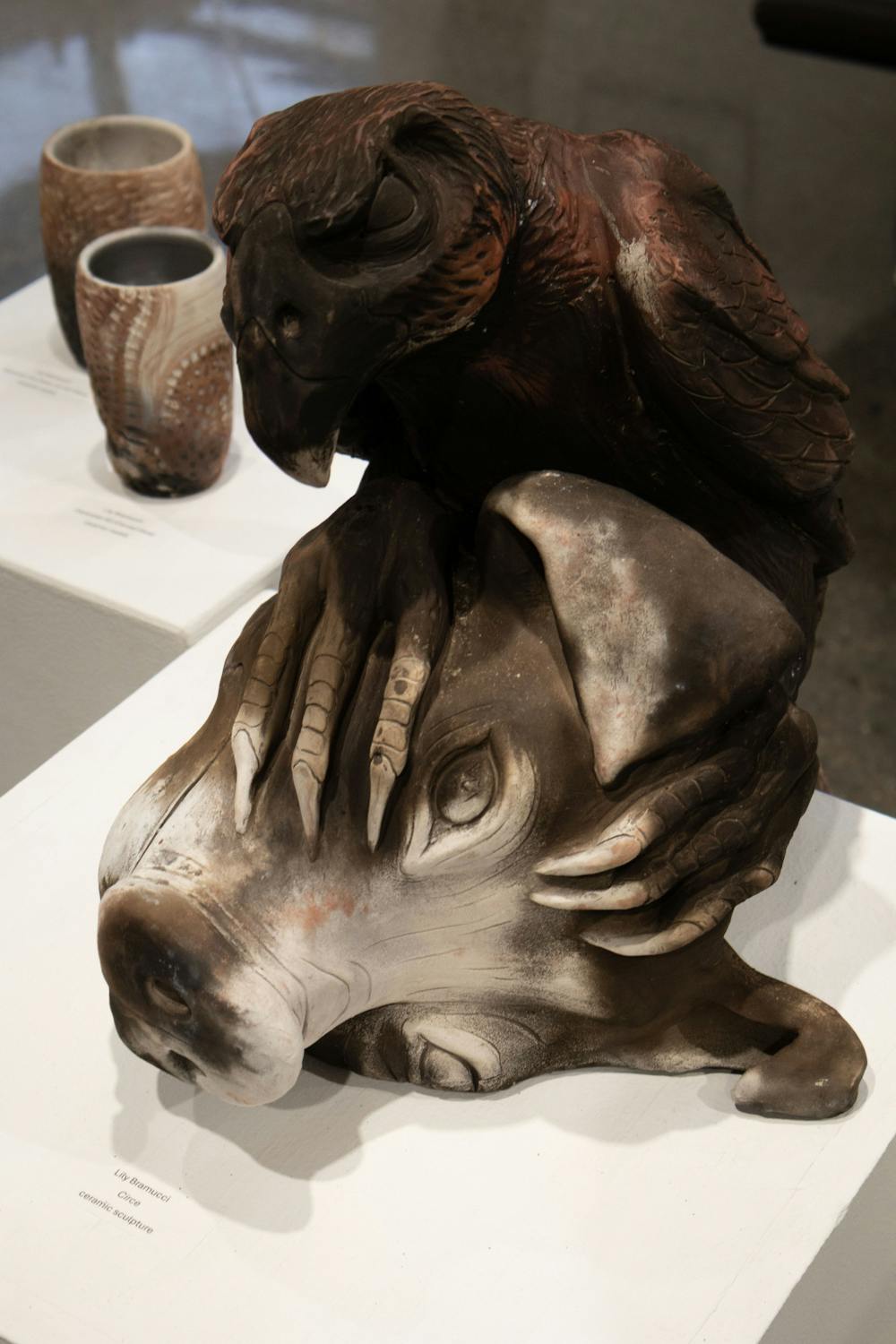
Lily Bramucci’s “Circe” ceramic sculpture.
Bramucci used ceramics and pit firing to explore hardship, choice and personal growth.
“When you do a pit firing, it’s essentially like making a big bonfire with your clay,” Bramucci said. “You have a lot of decisions to make like what you’re burning, how much and where you place each piece.”
She said the process connects to how people change through difficult experiences.
“In life, when you’re faced with hardship, you’re presented with a lot of choices,” Bramucci said. “The results might not be as physical, but they’re still noticeable.”
Professor Kathryn Keeley, who helped guide the senior seminar and assisted with installation, said the work came together naturally across the two senior capstone exhibitions.
“It was amazing how it all came together,” Keeley said, adding that the groupings were random, but the work still aligned visually and thematically.
“I didn’t pay attention to mediums,” Keeley said. “It just worked out when they were all kind of black and white, with a little bit of color, but not too much.”
The exhibition marked the end of the students’ undergraduate art careers while showing the range of themes and processes they developed at Shippensburg.

The Slate welcomes thoughtful discussion on all of our stories, but please keep comments civil and on-topic. Read our full guidelines here.