
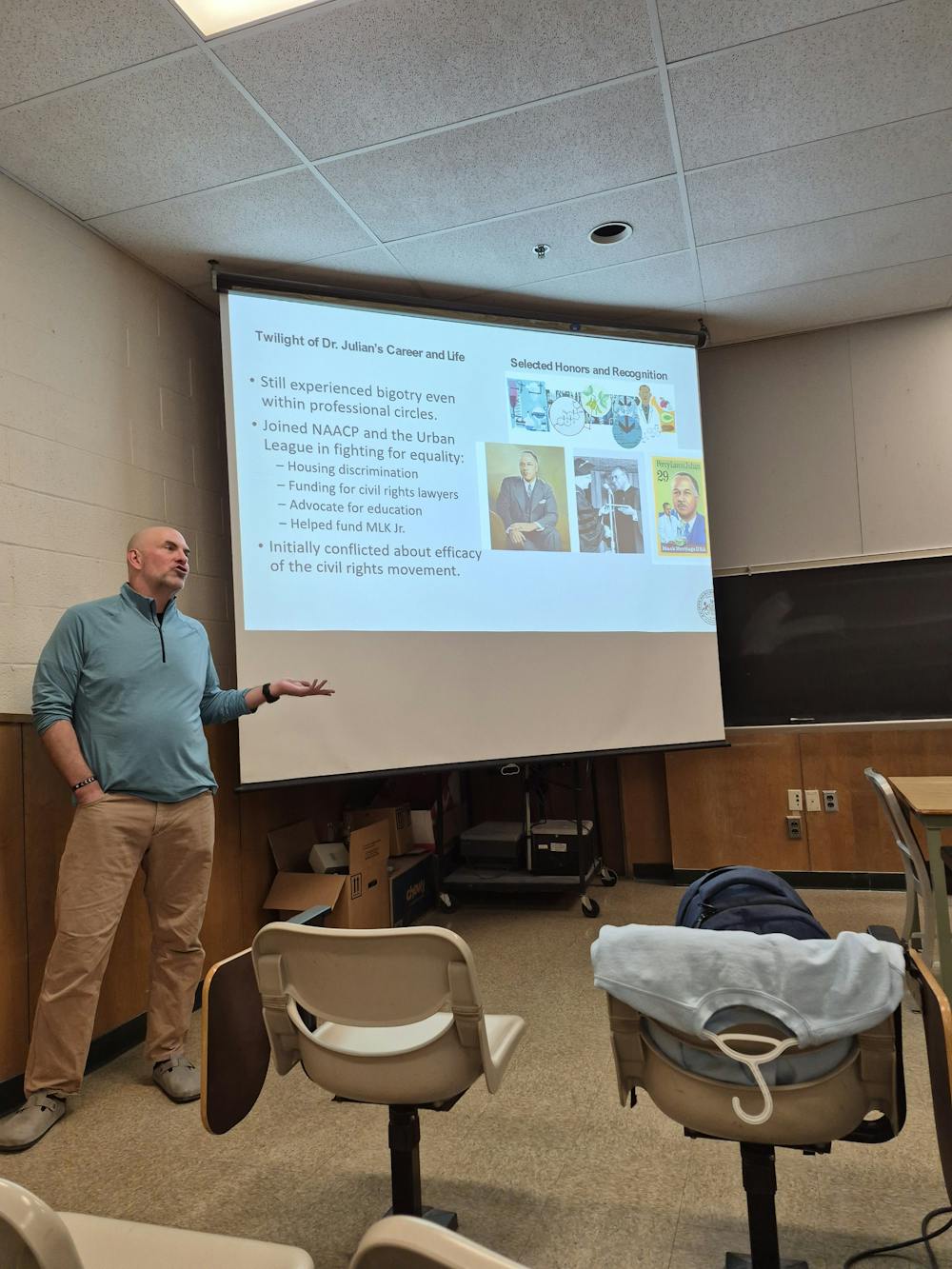
In celebration of Black History Month, students and professors gathered in Franklin Science Center for Professor Joseph Shane’s lecture to remember the Civil Rights Movement progress and scientific breakthroughs that Percy Levon Julian accomplished during his life.
With motivation from his son, Julian made great strides in the Civil Rights Movement. Julian joined the NAACP and Urban League, fighting for equality by helping with housing discrimination, getting funding for civil rights lawyers, was an advocate for education and helped fund Martin Luther King Jr. during Julian’s later years in life. In the beginning, he spent his time focused on growing his scientific knowledge.
Julian was born in 1899 in Montgomery, Alabama, having a childhood where his grandparents and parents encouraged his educational growth every step of the way. He attended school until eighth grade, followed by two years in a teacher training program. Then he went on to attend DePauw University, leaving as valedictorian and starting an extensive career in science. According to Shane, when Julian passed away in 1975 at age 76, he held over 130 chemical patents.
Two plants Julian worked with led him to make innovations for people’s health that were revolutionary. He worked for the Glidden Co., first with the Calabar bean, and then later soybeans.
Julian developed physostigmine, derived from the Calabar bean, which was the first effective medication for treating glaucoma.
Another achievement while he was working at the Glidden Co. was developing a means of synthesis for a precursor of cortisone drugs at a low cost. Cortisone, a pain-relieving medication, allowed individuals with crippling arthritis to function.
He held the role of director of research at the lab in Chicago’s soybean laboratory and processing facility, funded by Henry Ford.
Soybean research led to innovations because of the proteins. Julian developed “AeroFoam,” which was used in World War 2 for fighting fires on navy ships, along with a wide variety of uses in paints, plastic, food additives and linoleum. Even ushering in developments in large-scale steroid chemistry, pioneering the future for birth control medication research and affordability.
After working at Glidden Company, he created his own company known as Julian Laboratories making better, more affordable Cortisone and other steroids. He sold these products at as low a cost as possible, even though he could have made more money to an excessive degree; he believed everyone should have quality medicine without a driven-up price because it was the morally correct thing to do.
His path prior to working at Glidden Company and getting the degrees he worked diligently for was bombarded with obstacles. Before his discoveries and pivotal research, he spent his time at multiple Universities. Julian worked teaching chemistry at Fisk University in Nashville, TN. Afterwards he set his sights on attending Harvard for further education.
Initially denied attendance at Harvard because, while academically prepared, they said he would not be able to get a job after. After continued perseverance, he got accepted to Harvard and went there for four years to get his master’s degree. Upon completion, he was denied for their doctoral program.
Deciding Europe would be his next stop, he completed his Ph.D. at the University of Vienna with funding from the Rockefeller Foundation, doing research in the isolation of alkaloids from Corydalis Cava plants in 1931. There, he learned German so he could publish papers, as German was the language used for all chemistry publications in Vienna. He also became avidly interested in learning piano and tennis, and he developed a liking to opera.
After his Ph.D. studies, he joined the faculty at Howard University after a brief time at West Virginia State College. He then returned to DePauw University as a research associate after resigning from Howard University. His resignation came from of a dispute instigated by university president Mordecai Johnson, Julian and another chemistry professor, Jacob Shohan, ending each other’s careers at Howard University.
After the turmoil, Julian went back to working at DePauw University with undergrad students. He also published 11 papers and received a U.S. research grant.
With his portfolio piling up with success, he was unable to get a faculty position at DePauw.


The Slate welcomes thoughtful discussion on all of our stories, but please keep comments civil and on-topic. Read our full guidelines here.