
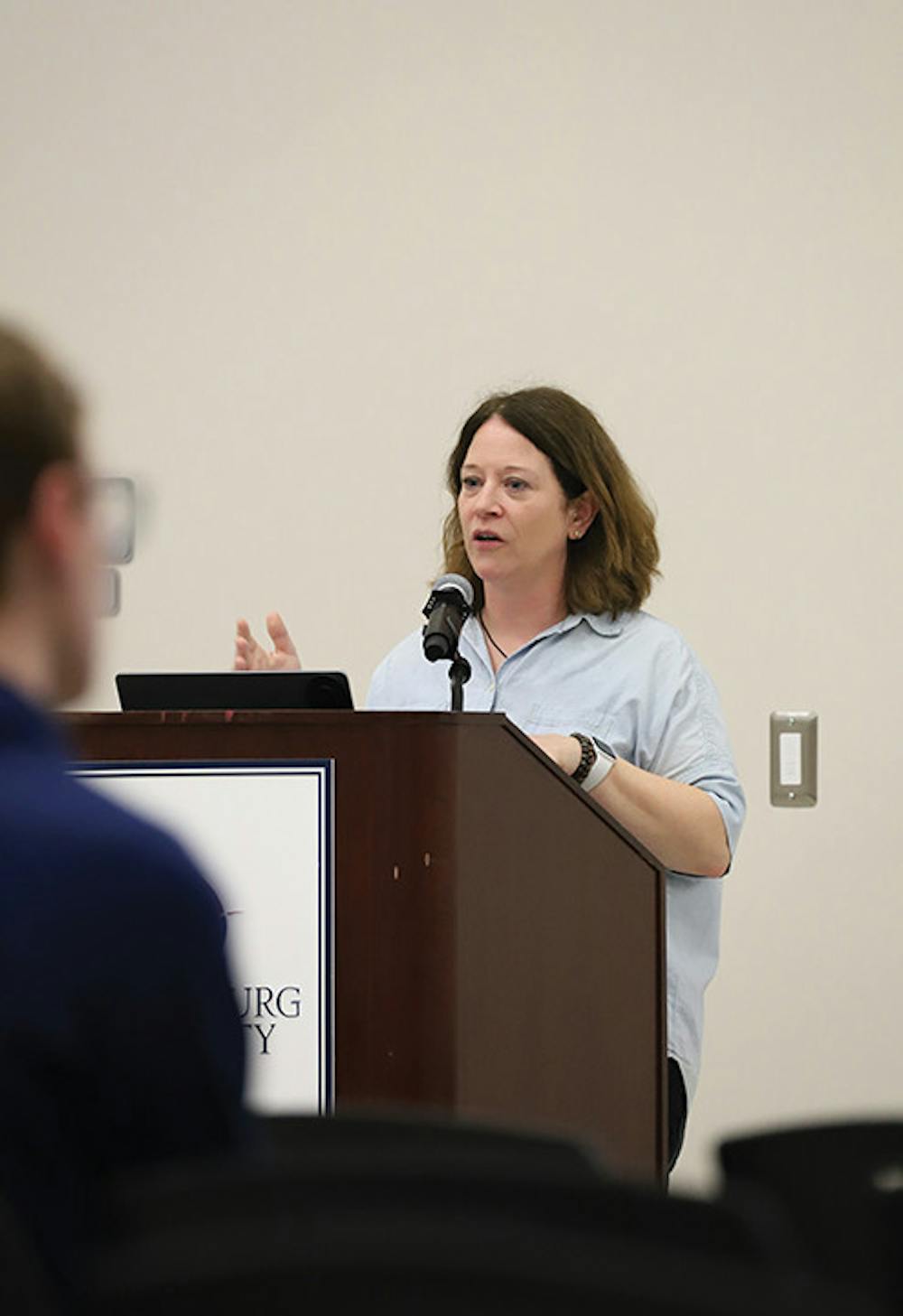
SU Communication, Journalism and Media Assistant Professor Stephanie Witmer held a talk focusing on writing about women’s health and dismantling stigma titled ‘Body of Work’ on Thursday, April 9, in the CUB MPR.
Women’s and Gender Studies program Interim Director Cristina Rhodes welcomed Witmer to the stage and provided a brief background to Thursday’s lecture.
“Professor Witmer will share behind the scenes anecdotes to discuss what’s changed and what hasn’t in the coverage of women’s health amidst the influence of social media, the rise of wellness culture and shifting political landscapes,” Rhodes said.
Witmer spoke from her 30-year experience as a professional magazine and digital journalist when considering what has changed in the media landscape since the 1990s.
She started by detailing her inspirations in the journalistic world and her career path toward magazine writing. The story that drove her passion toward journalism was an Esquire feature story titled “The American male at age ten” by Susan Orlean.
“I couldn’t believe I had spent 20 minutes or however long reading about this kid that I didn’t even know. She was able to capture his voice and make him seem incredibly fascinating and interesting,” Witmer said. “Susan Orlean made her whole career … finding the extraordinary within the ordinary, seeing that everyone had a story to tell.”
Focusing on stories that are not being told and leading with empathy were the themes of Witmer’s lecture. She recounted a story she wrote about endometriosis, an under researched condition many women experience which causes severe pain, leading to negative mental and physical health outcomes.
“It is an invisible disease, and its one of those conditions that oftentimes get blown off by the medical community. They don’t believe that this condition is as severe and as debilitating as it actually is,” she said.
One article Witmer wrote and won awards for focused on menopause and a flawed study that ended hormone therapy research for 20 years.
“For 20 years, women were lacking access to things that could help their symptoms,” she said. “The media was reporting that if you take hormones you are going to get breast cancer. That is absolutely not accurate whatsoever.”
These false reports prompted many women to avoid treatment for menopause symptoms out of fear.
Women’s health gaps were a major topic of Witmer’s lecture. Health gaps refer to a sharp difference between the medical care needed and the care that is provided for different demographics, according to Witmer. Women’s health research is one area with a major gap.
“Only five percent of global research and development is allocated to women’s health research … four percent of that is research for women’s cancers. One percent of that is for all other things women specific, and 25% of that one is specific to fertility research,” she said. “That excludes a lot of research for a lot of other conditions … These are things like autoimmune disease, which affect women 80% to men’s 20%.”
Women are also underrepresented in medical research trials due to fears of harm to fertility. These medical trials are where medications are approved or rejected. While the number of women participating has been improving, according to Witmer, there are still some noticeable disparities.
“Women of color are even less likely to be represented in any sort of health research, but they are far more likely to be underdiagnosed, to be ignored by their healthcare providers, to receive a delayed diagnosis, to be forced to cope with pain longer and the experience more complications,” she said.
Due to a lack of research, there is also less information available for journalists to distribute to the public.
The public confusion surrounding women’s health has led many women toward wellness culture to find alternatives, Witmer said. Wellness culture focuses on personal wellbeing rather than public health concerns.
“Wellness culture doesn’t talk about poverty. It doesn’t talk about food insecurity or gun violence or health risks that are related to climate change, because wellness culture is often focused on products. It’s a lot easier to sell personal optimization than it is to sell public health,” she said.
As she finished her lecture, Witmer addressed the journalism students in the audience when speaking about the need to provide good information to the public.
“In media, we know these things to be true: when there is a lack of information, a lack of research, the void does not stay empty. The void is filled with other things. The void is filled with rumors, with gossip, with speculation or misinformation. When people hear a story for the first time, that’s the version they usually believe, even when they’re faced with new, conflicting information,” she said.
Thursday’s lecture concluded with a brief round of questions, which largely centered on Witmer’s career.



The Slate welcomes thoughtful discussion on all of our stories, but please keep comments civil and on-topic. Read our full guidelines here.