
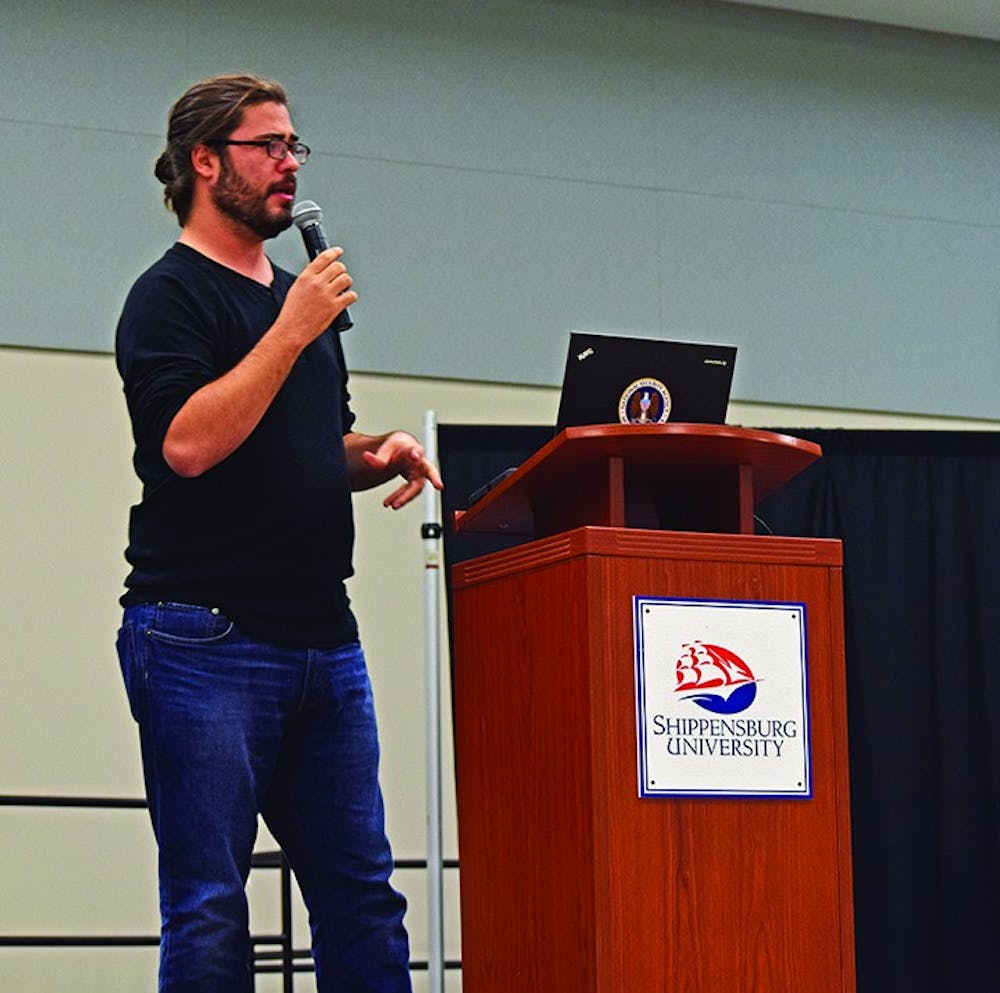
A technologist of the American Civil Liberties Union visited Shippensburg University on Wednesday to discuss the privacy and freedoms available in today’s digital age, as well as what information can be accessed by the government.
Christopher Soghoian, a former employee of the U.S. Federal Trade Commission, served as the first in-house technical adviser to the Division of Privacy and Identity Protection. Named as a top innovator over the age of 35 by the MIT Technology Review, he is considered an expert in subjects such as privacy, surveillance and information security.
In the Ceddia Union Building’s multipurpose room, Soghoian lectured on topics ranging from the limits of government surveillance to his own thoughts on how citizens should protect their privacy online.
Soghoian said that one of the biggest issues citizens face with privacy is webcam hackers, and urged the audience to begin covering their laptop cameras when not in use. He also said that the only truly secure applications are iMessage, FaceTime and WhatsApp.
“This [using these apps] is a self help technique that will protect you not only from an ex-boyfriend or stalker, but from the FBI,” Soghoian said. “We live in a weird time. There’s not going to be less hacks, there’s going to be more hacks.
According to Soghoian, there has been a relatively friendly relationship between phone companies and law enforcement for about 100 years. However, as technology companies such as Apple and Microsoft began to become more widely used, government agencies began to reach out further than the phone companies.
“As we move our communication to new technology, the government has followed,” Soghoian said. “It’s really difficult to build a secure device, [and] newer companies are worse at it than older companies such as Apple or Microsoft.”
In 1928, former Supreme Court justice Louis Brandeis warned the Supreme Court against allowing companies to create devices containing unbreakable encryptions. More than 80 years later, Apple CEO Tim Cook announced that the newest Apple products at the time were protected by end-to-end encryption, meaning that all activity performed on an Apple device was essentially inaccessible to the company and to law enforcement.
In 2009, while at a conference in Washington, D.C., Soghoian said he learned of a self-service website created by Sprint where government agencies could log in and obtain information about anyone with a Sprint phone plan. The phone company’s representatives said the website was created because of the enormous number of requests they were receiving each day from law enforcement to turn over phone records, and that it had become impossible to keep up with, according to Soghoian
Comparing the website to an all-you-can-eat buffet, Soghoian said that in less than a year the website was visited approximately eight million times.
Although Sprint assured its customers that records would only be shared in cases of suspected criminal activity, there was a growing concern that information previously believed to be private was now being circulated.
Since then, major technology companies such as Google have begun to release annual transparency reports, letting its users know the amount of information that is being turned over to law enforcement each year or every six months.
The Privacy and Freedom in the Digital Age lecture was held in conjunction with SU’s annual Proteus lecture series.


The Slate welcomes thoughtful discussion on all of our stories, but please keep comments civil and on-topic. Read our full guidelines here.