
How long can you stay in a private room at the library working with classmates on a group project before you feel the overwhelming urge to get some fresh air and clear your thoughts? Two hours? Maybe more, depending how well you get along with your peers.
Now imagine spending one year in relative isolation with five others. That is exactly what six recruits for the National Aeronautics and Space Administration (NASA) are doing in a desolate part of Hawaii, reported the BBC.
A white dome and a series of solar panels are the only shelter the team has to support its meager living for the next months. The structure is located on a flat, rocky surface in the shadow of one of Hawaii’s volcanoes.
The idea is to simulate what a mission to Mars would be like, specifically from the perspective of how humans interact. Each recruit is given a small, private room with a desk and cot, but otherwise there is hardly anywhere to be alone.
The members are allowed to leave the dome, but such an expedition demands they wear a space suit. If the lack of fresh air is not bad enough, the food is prepackaged and includes delicacies of canned tuna and powdered cheese.
Think back to being stuck in the library working on a group project — how many days could you sleep in the library, eating only food out of the vending machines and drinking water out of a fountain?
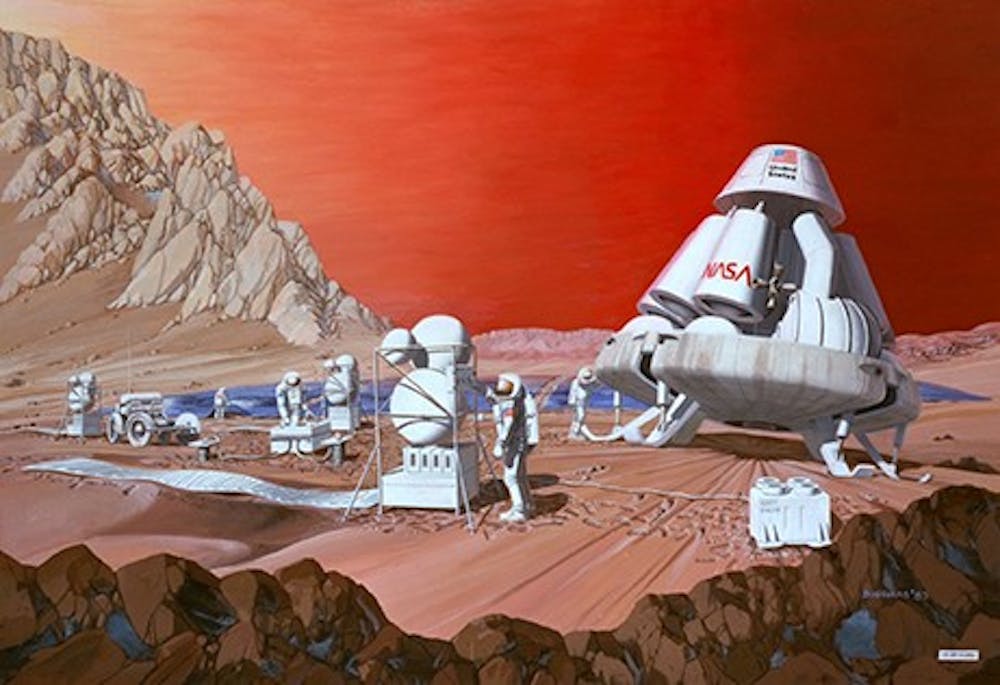
The team in Hawaii, however, is on a mission. They are taking another step toward figuring out how to send humans to Mars — a notion that has inspired books and movies and captured the imagination of everyone since the moon landing.
Though the merit in investing countless dollars and years of planning is hard to see when there are schools to fund, hungry to feed and global enemies to combat, there is also much to gain.
“Mars is a rich destination for scientific discovery and robotic and human exploration as we expand our presence into the solar system,” NASA.gov states.
NASA’s broad terminology is not necessarily convincing to opponents of space travel who think the money could be better spent elsewhere.
One simple way of thinking how a trip to the red planet is worth taxpayer money is remembering the fact that many great inventions were by-products of accomplishing something else. Therefore, the technology developed for the mission may be used to better the lives of people all over the world.
The program to send the first human to Mars is still years away, but just because there is no news of a new spacecraft being built does not mean people around the world are not hard at work.
The team in Hawaii is doing its part to find a way to travel the 140 million mile span to the red planet while still maintaining a healthy relationship with their colleagues.
The U.S. government did its part in 2010, when the NASA Authorization Act was passed.
Two goals from the act and from the U.S. National Space Policy, are aimed at putting humans on an asteroid by 2025 and on Mars during the 2030s.
The space age could truly be on everyone’s doorstep, but until then, remember that whenever you are stuck at the library this academic year, there will be six people stuck in a dome somewhere in Hawaii.


The Slate welcomes thoughtful discussion on all of our stories, but please keep comments civil and on-topic. Read our full guidelines here.