
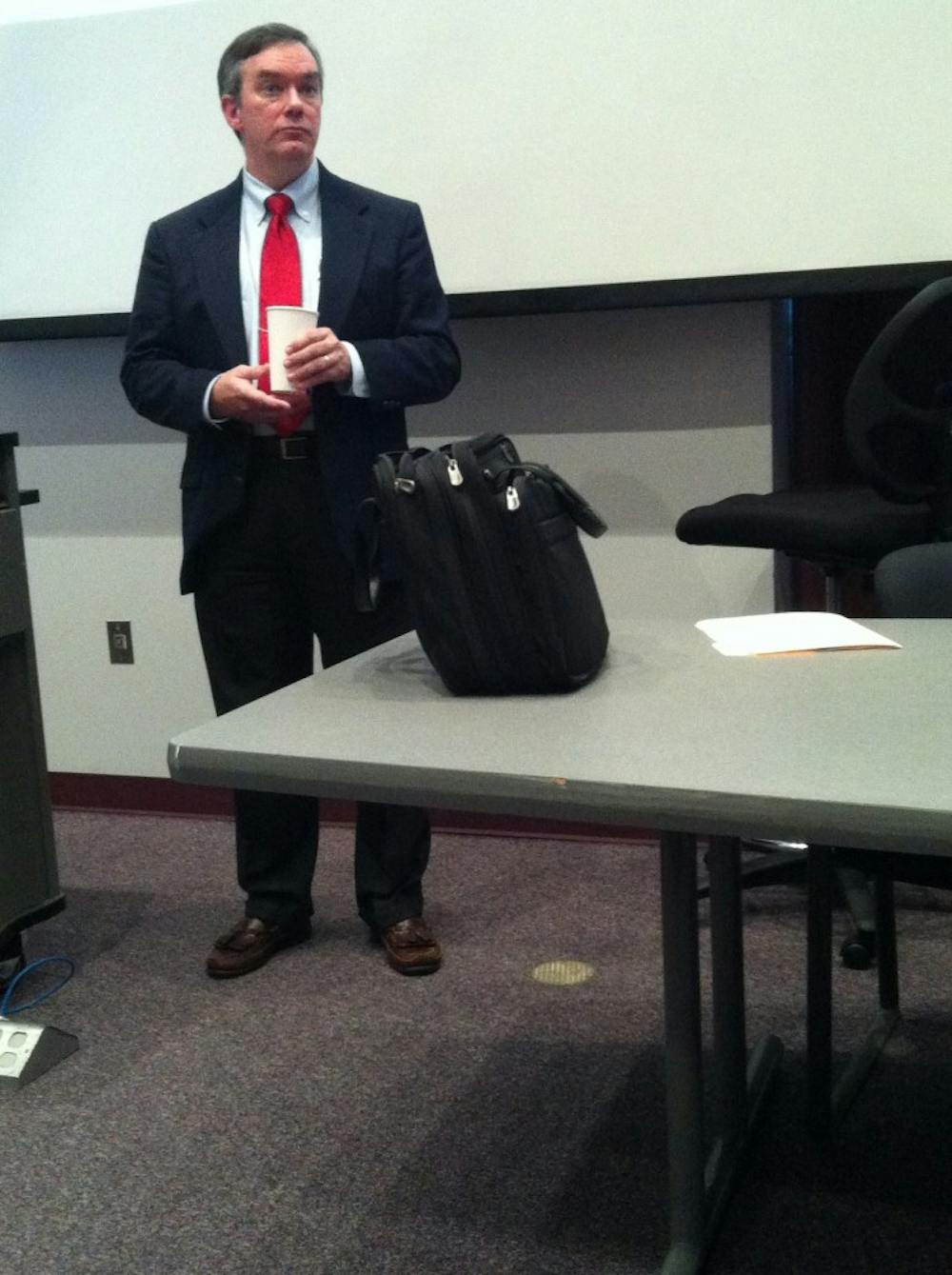
Grove Hall Forum was packed with more than 200 people on Sept. 11 as the community came to learn new information concerning the Holocaust.
Geoffrey Megargee is a senior applied research scholar at the Center for Advanced Holocaust Studies, United States Holocaust Memorial Museum.
His talk, free to the public, focused on the German military’s involvement with the Nazis and the complexity of the German camp system.
Although German soldiers were not allowed to join political organizations, the Nazis infiltrated the military.
While soldiers used to swear allegiance to the German constitution, Megargee said they swore it personally to Hitler.
The military then assisted the Nazis in setting up camps throughout Europe.
When Megargee’s team first set off to research for the “Encyclopedia of Camps and Ghettos, 1933-1945,” a seven-volume work of which Megargee is the project director and editor-in-chief, it intended to visit between 5,000 and 7,000 sites.
However, this number grew quickly.
“The more we dig, the more we find. At this point we have a working total of 42,500 sites,” Megargee said.
This number includes “euthanasia centers,” places where children and adults with physical and mental disabilities were sent, and approximately 500 brothels scattered throughout occupied Europe, where many women were forced to work.
In Nazi Germany, there were 30,000 forced labor camps for non-Jews and 2,400 similar camps for Jewish people.
The Holocaust ended about 70 years ago, but that does not mean genocide is no longer a problem.
In recent history, “ethnic cleansings” continue to disrupt global politics, including cases in Rwanda and Bosnia.
According to Mark Spicka, interim history department Chairman at SU, events like this are why it is important to continue studying the holocaust.
“I think it’s important for students to be able to look at the past and hopefully learn from it and see what kinds of patterns, what kinds of factors led to the Holocaust and Nazi Germany in the 1930s and 1940s.”
In 1994, a similar episode ensued.
“History isn’t static. It’s a constant relationship between past and present,” Spicka said. An estimated 800,000 Rwandans lost their lives in civil war, most of them minorities, BBC reported in 2008.
According to the Holocaust Museum of Huston’s website, around the same time, “Serbia set out to ‘ethnically cleanse’ Bosnian territory by systematically removing all Bosnian Muslims, known as Bosniaks.”
According to David Wildermuth, professor of German at SU, preventing these events begins with tolerance.
“Any scholars of the Holocaust see that the basic premise of such heinous crimes is built on this sense of intolerance, this sense of the other, that they are different and therefore must be expunged from the common body,” Wildermuth said.

The Slate welcomes thoughtful discussion on all of our stories, but please keep comments civil and on-topic. Read our full guidelines here.