
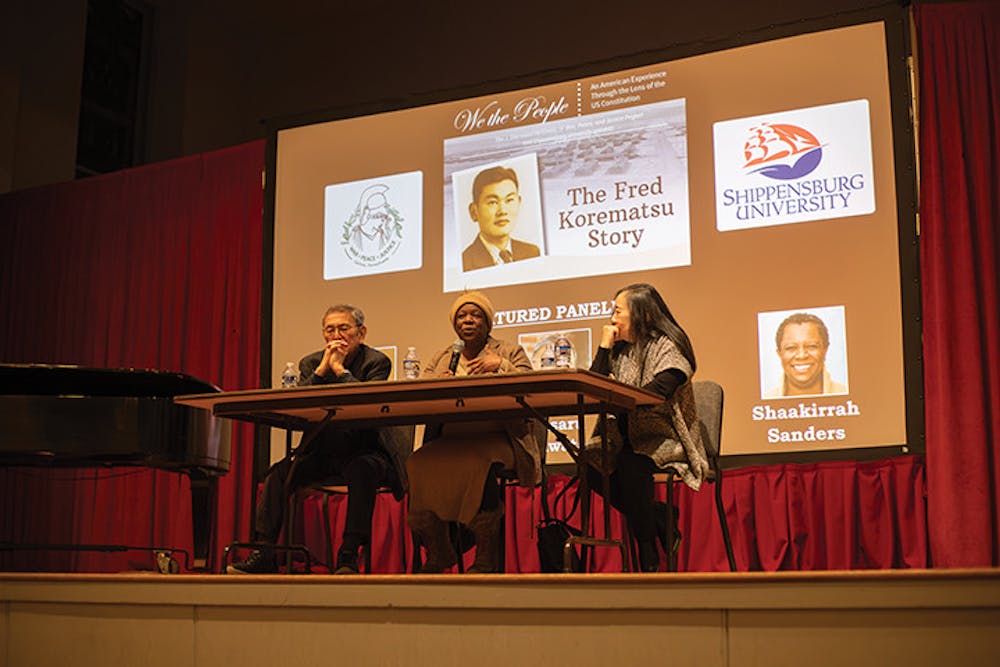
On Thursday, Jan. 29, a student-organized panel at Old Main Chapel used Korematsu v. United States to examine how constitutional rights can narrow during war and how executive actions taken in the name of national security can persist long after the crises that produced them.
The panel discussion followed a screening of the documentary “Of Civil Rights and Wrongs: The Fred Korematsu Story” and was presented as part of “We the People: An American Experience Through the Lens of the U.S. Constitution,” a series hosted by the J. Sherwood McGinnis Jr. War, Peace and Justice Project. Political science professor Steven Lichtman introduced the speakers, framing the evening as a constitutional discussion grounded in a single Supreme Court case but extending into modern debates over power and rights.
The event was organized by Lindsey Heiser as part of her senior capstone project at Messiah University. Heiser said the project grew out of her realization that she had little exposure to Korematsu’s case despite studying political science and pre-law.
“Me personally, I had really little background,” Heiser said. “My whole career is focused on law enforcement.” She added that Korematsu’s story “wasn’t really brought up” in her coursework.
At the center of the discussion was Fred Korematsu, a Japanese American welder who refused to comply with a 1942 military order requiring people of Japanese ancestry on the West Coast to report for removal and incarceration. Arrested and convicted, Korematsu challenged the policy, but the U.S. Supreme Court upheld his conviction in 1944, accepting the government’s claim that mass removal was a military necessity.
Decades later, evidence surfaced showing the government had withheld intelligence reports undermining those claims. Korematsu’s conviction was eventually vacated, though the Supreme Court’s original ruling was never overturned.
Attorney Lorraine Bannai connected that history to her life and career. Bannai, a third-generation Japanese American, said her parents, grandparents, aunts and uncles were incarcerated at Manzanar. She first encountered the case in law school and remembered being “outraged” by the decision. Years later, she became part of the legal team that succeeded in overturning Korematsu’s conviction.
Bannai emphasized effort extended beyond the courtroom. “This was not just a legal case,” she said. “We also had to talk about the case, because the law is just a piece of paper.” She said public understanding was essential to explaining what happened to Japanese Americans and what was done “in the name of trying to keep ourselves safe.”
During the question-and-answer portion, Bannai addressed parallels she sees in current immigration enforcement. She described people being detained “on the suspicion that perhaps they’re undocumented,” often without charges or individualized evidence, and cited enforcement at places such as Home Depot, schools and courthouses. She compared those practices to wartime military actions against civilians, arguing no declaration justifying such force exists.
Shaakirrah Sanders, a constitutional law professor at Penn State Dickinson Law, said her first meaningful exposure to Korematsu’s story came at home rather than in school.
“I kind of had one of those mothers who kept receipts on America,” Sanders said, recalling being told about Japanese American incarceration after it was omitted from a World War II lesson. She said that absence shaped how she thinks about constitutional power and who is excluded from formal education.
Asked whether the Constitution is being “manipulated,” Sanders views the issue as one of interpretation, noting the document has long divided people into categories with lasting consequences.
The final panelist, Japanese American organizer Masaru Nakawatase, said his worldview has been shaped directly by the policy. Born in an incarceration camp, Nakawatase said his experiences led him to be skeptical of the courts as the sole engine of justice.
“I think there should certainly be skepticism about the Supreme Court as an instrument of justice,” Nakawatase said. “It has been an instrument of justice at times, but it has also been the opposite.”
Still, Nakawatase said the legal system can and should be used. He expressed gratitude for attorneys and judges who continue to push back against unchecked power. “I am so grateful for the lawyers on the front lines right now, using the tools available to them,” he said.
Nakawatase urged the audience not to rely solely on court rulings, emphasizing the importance of public pressure and civic engagement. “You have to use the courts, but you also have to use the streets,” he said. “Write those letters, write congressmen, demonstrate—that’s where justice comes down.”
Throughout the evening, speakers returned to a shared conclusion: Korematsu’s story endures not only because of what happened during World War II, but because of how it is remembered, taught and applied. Panelists said the case continues to shape the nation’s understanding of civil liberties, fear and the constitutional limits of government power, particularly during moments of crisis.


The Slate welcomes thoughtful discussion on all of our stories, but please keep comments civil and on-topic. Read our full guidelines here.